Disrupted transition to a modern state and economy.
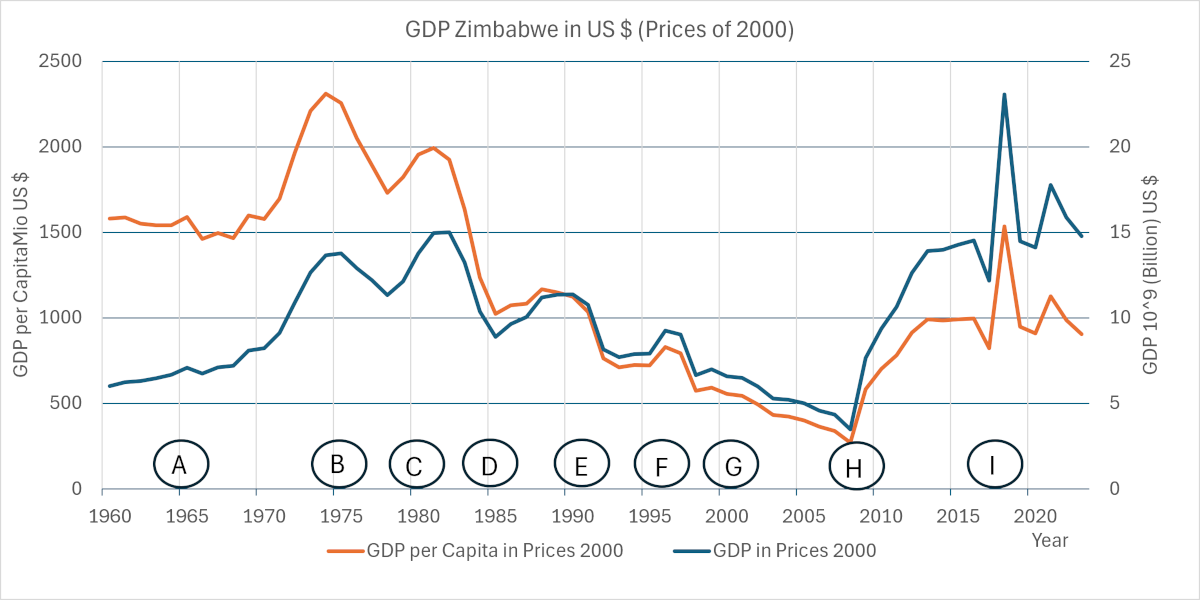
GDP from 1960 to 2023
Click on pictur to enlarge. Grafics AM, sources look right.
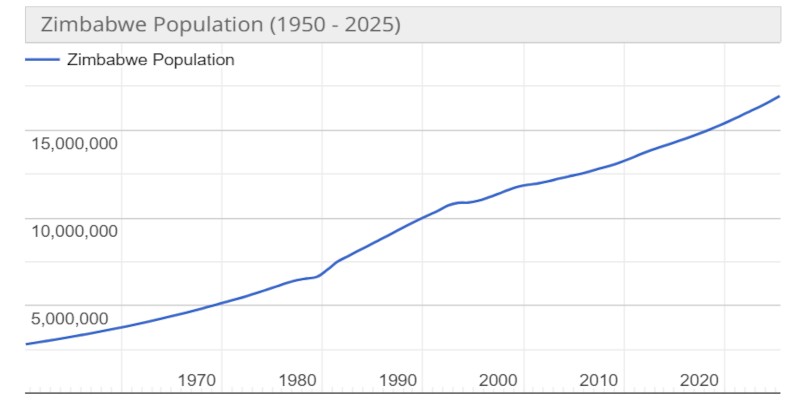
Population 1960 to 2024
Click on picture to enlarge. Sources look right.
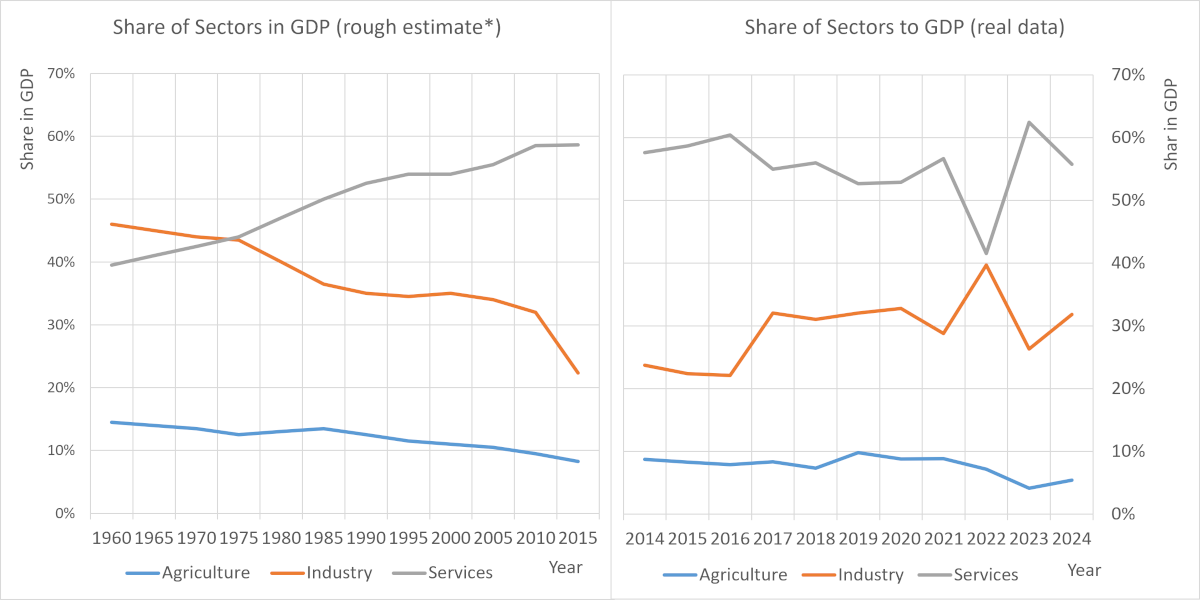
Share in GDP (agriculture - industry - services)
Click on pictur to enlarge. Grafics AM, sources look right.
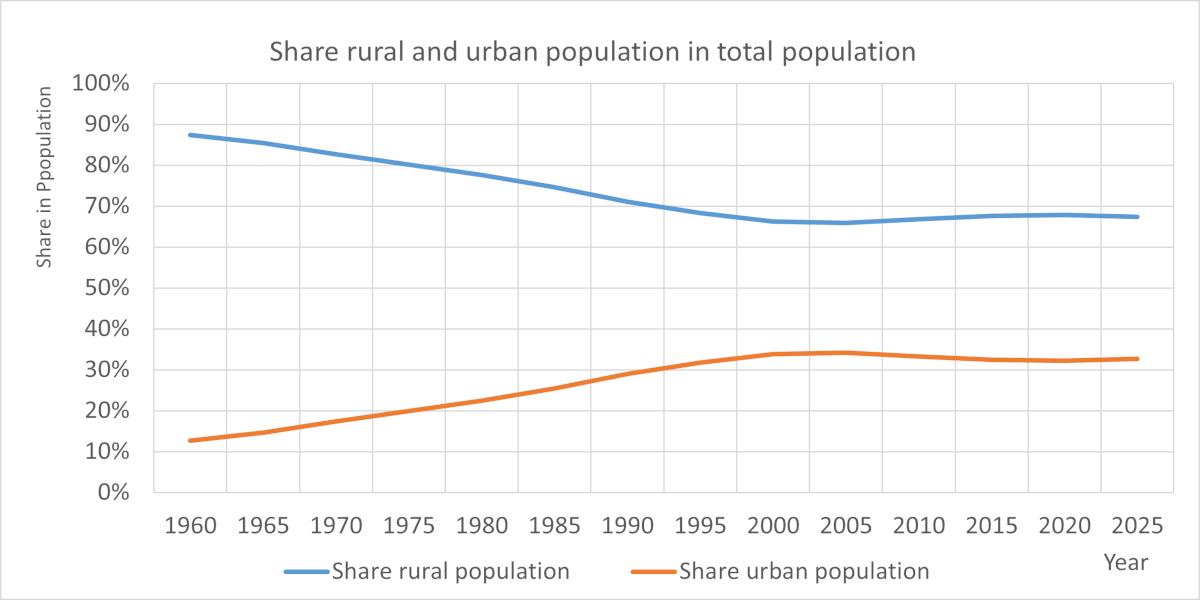
Share in Population 1960 to 2025 (rural-urban)
Click on picture to enlarge. Sources look right.
What can we learn by the charts?
The industrial share of the economy declined from 1960 onward, with a sharper downturn during the liberation war. As the conflict intensified around 1975, the GDP chart shows a severe contraction in gross domestic product. There was some recovery both before and after independence in 1980. Only after 2015 did GDP return to approximately the level of 1980. During this period, Zimbabwe’s population grew from about 7 million inhabitants in 1980 to roughly 15 million in 2015. The long decline in GDP, with its small fluctuations, reflects the political disruptions that shaped Zimbabwe’s nation‑building process. From 2015 onward, the industrial sector appears to stabilize somewhat, although after 2018 the charts indicate volatile attempts at improvement.
GDP alone does not fully reflect the economy of a country in which more than 80% of the workforce operates in the informal sector. Subsistence agriculture — more than 65% of the population lives in rural areas — and food production cannot be extracted from the available data. However, it is clearly visible that the share of commercial agriculture has fallen below 10% of GDP.
Events and Phases
1965 UDI: Unilateral Declared Independence
1975 Intensification of Liberation (Civil) War (Mozambique independent)
1980 Zimbabwe independent
1983 Begin of Gukurahundi, 1987 Unity Accord ZANU/ ZAPU
1990 ESAP: Economic Structural Adjustment Program
1996 Rainfalls after severe drought gave short release
1997 Deep Crisis ("Black Friday") , Clash MDC/ ZANU PF, Fast Track Landreform
2008 Elections, Government of National Unity (2009 - 2013), ZANU PF
2017 Robert Mugabe forced from power, Presidency of Emmerson Mnangagwa
Data from 1960 to 2014 are estimated by different approaches of CoPilot/ chatGPT. The methods are not documented here. I propose to restart a chat if onde wants to be more scientific.
Hope, struggle, renewal, struggle: The story of independent Zimbabwe
Zimbabwe experienced a period of consolidation from 1980 to 1990, drastic measures taken by the government and the IMF in the ESAP program from 1990 to the end of the millennium, violent land seizures around 2000 with the decline of the economy leading to hyperinflation in 2008, the phase of the Government of National Unity from 2008 to 2013, and the return to sole rule by ZANU (PF) from 2013 till today (2026), with the turning point of Mugabe's removal in 2017. From 2018 Emmerson Mnangagwa is president elected.
The 1980s. A new beginning and violence
After the settler regime was removed, a heavily externally financed expansion of the education and health systems took place from 1980 to around 1990. The economy continued to be based on the state-interventionist system of the settler economy. The latter was characterized, for example, by the fixing of agricultural prices before sowing.
The state unity of the multi-ethnic population, combined with fantasies of a single party, was reinforced by military force. The military operation against dissidents of ZIPRA (ZAPU Liberation Army) became a brutal punitive action against the population, with, according to some estimates, 20,000 victims in Matebleland.
The 1990s. ESAP and failure.
The next phase from 1990 to 2000 was initially characterized by market economy enthusiasm and later by violent land expropriation. From 1990 onwards, the government and the International Monetary Fund believed that Zimbabwe's economy was growing too slowly in relation to its population and compared to the global economy. (Compared to the average growth of the global economy of around 4%, this was 1 percentage point too low, i.e., 3%). The resulting EASP program caused the traditional economy to collapse without developing market-based expansion (similar to the former GDR—except that Zimbabwe did not have a Western FRG). In the 1980s and 1990s, ZANU failed to deliver on its promise to provide fertile settler land for small and medium-sized farmers.
The years around and after 2000. Violent land reform.
ZANU (PF)'s unconditional desire to retain power, coupled with a strengthening opposition, economic collapse, the unresolved land issue, and the termination of financial support from Great Britain in 1998 (Blair did not honor Thatcher's verbal commitment) culminated in state-sponsored violent land seizures at the turn of the millennium. The years 2000 to 2008 were marked by the takeover of the country by ZANU officials, war veterans, and Zimbabweans selected according to criteria that were difficult to understand and who were not from the ZANU milieu. They were marked by intense, brutal persecution of ZANU's political opponents, often in rural areas. They were marked by violent law enforcement measures such as the destruction of illegal settlements and sporadic crackdowns on the informal economy. The formal economy collapsed by more than 50% of gross national product.
2008 to 2013 (GNU) and beyond to 2017.
With the government of national unity from 2008 to 2013, the economy recovered slightly, presumably due to increasing foreign investment. The Zimbabwe dollar was replaced by the South African Rand and US Dollar. The political opposition split and weakened during this upswing, and a pure ZANU government followed from 2013 to the present, interrupted by Mugabe's replacement by Manangawa in 2017.
The Second Republic.
Emmerson Mnangagwa is the president of that wha is called then Second Republic. He explicitly wants to industrialize the country: Agriculture, Mining, Manufacturing. The fall of Robert Mugabe has many reasons. One of the most important was, that the Chinese government and enterprises did not trust Zimbabwe under Robert Mugabe (respective his wife Grace) and feared for their investments and loans. Emmerson Mnangawa was sworn in by November 24, 2017 and elected president by July 30, 2018. He now (2026) is electeted until 2028. 2017 was the beginning of a big flow of chinese investments into Zimbabwe: Tobacco, Cement, Ferro Chrome, Lithium, Steel, Electric Power, Infrastructure like the Airport.
It is a very volatile industrialzation. All over you see islands of renewal and development. Nevertheless infrastructure and local productive business can not follow.
Emmerson Mnangagwa is the president of what is now called the Second Republic. From the beginning, he has presented himself as a leader committed to stepwise industrializing the country — with a focus on agriculture, mining, and manufacturing.
The fall of Robert Mugabe in 2017 had many causes. One of the most decisive was the growing distrust among Chinese state institutions and enterprises, who increasingly feared for the security of their investments and loans under Mugabe’s unstable late‑stage leadership — especially as his wife, Grace Mugabe, positioned herself as his potential successor.
Mnangagwa was sworn in on 24 November 2017 and elected president on 30 July 2018. As of 2026, he is serving a term that runs until 2028.
The year 2017 marked the beginning of a major wave of Chinese investment into Zimbabwe — in tobacco, cement, ferrochrome, lithium, steel, electric power, and infrastructure such as the expansion of the international airport.
This industrialization, however, remains highly volatile. Across the country, one sees islands of renewal and rapid development. Yet the broader infrastructure and local productive capacity struggle to keep pace, creating a landscape of uneven and fragile growth.